July 1st, 2025 started like any other normal day with our almost five-month-old baby boy, C.
He’d been up at 3am happily chatting in his bassinet, then woke again around 8am, extra cuddly.
He had a quick feed – nothing unusual for him.
As the morning went on, he felt warm. His temperature was only 37.5°C, but he was quieter than usual and just didn’t seem himself.
We booked a GP appointment for later that afternoon, thinking he might have been teething. After some paracetamol, he fell into a long nap – which was unusual for him. When he woke, his temperature had crept up.
I fed him again, but this time he kept unlatching, grunting, and his heart felt like it was racing. We decided to put on his Owlet smart sock; his resting heart rate was 185 bpm.
Even though there weren’t any obvious signs something was seriously wrong, both my husband and I instinctively knew something wasn’t right. We decided to take him straight to our local emergency department.
By the time we got him into the car, he looked drowsy but wasn’t asleep, and he was making a constant groaning sound, like he was in pain. The five-minute drive to the hospital and the five-minute wait to see the triage nurse felt like a lifetime.
We worried we’d be dismissed as “anxious first-time parents,” but thankfully, the nurse took our concerns seriously. We were taken straight to a bed where nurses and a doctor began assessing him.
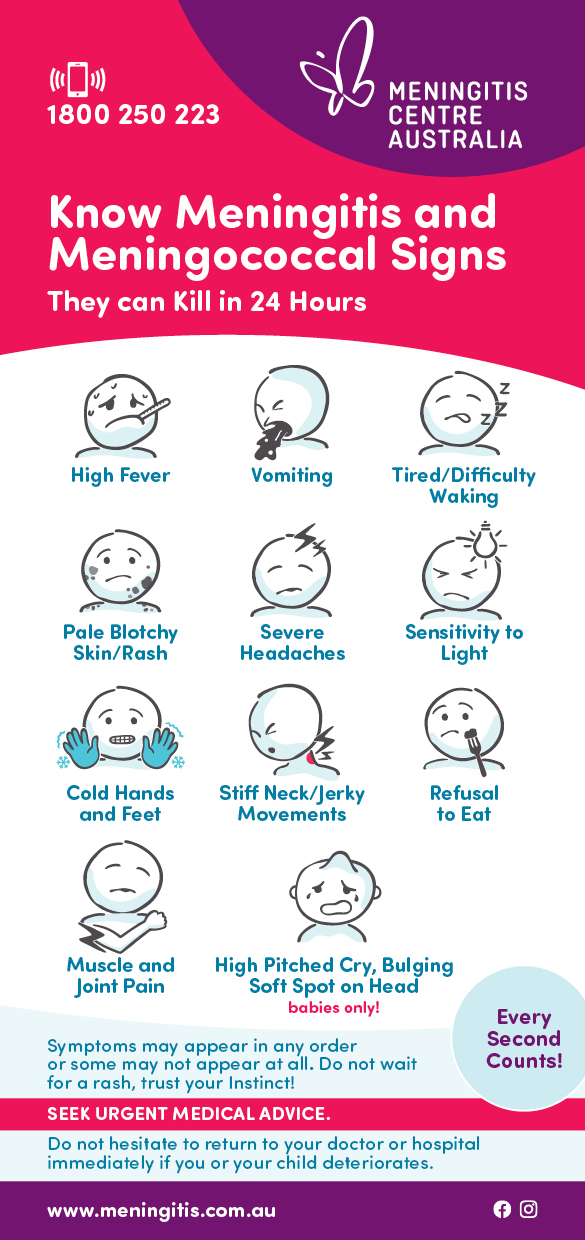
Soon after arriving, our son’s condition started to deteriorate. He was vomiting, refusing feeds, and his fontanelle began to bulge. He was restless, uncomfortable, and clearly in pain. The ED doctor ordered a chest X-ray, swabs, blood and urine tests – but there were still no clear answers.


As a precaution, they started IV fluids and antibiotics and admitted us to the paediatric ward, expecting we’d be there a few days. Once we were settled in our room, I went home to pack an overnight bag.
Not long after I arrived home, I got the call every parent dreads, my husband told me the paediatrician suspected meningitis and needed to perform a lumbar puncture urgently. I was in utter disbelief. Meningitis? How could that happen? As I raced back to the hospital, I walked onto the ward to the sound of my baby screaming from the treatment room. My husband and I reunited and both broke down. We’d done everything we could to protect our baby: how could he be so sick?
After the procedure, the incredible nurses brought him back to us. We held him close, not wanting to let go.
The paediatrician soon returned and showed us the spinal sample. It looked consistent with meningitis. They immediately began antiviral treatment alongside the antibiotics and IV fluids. We were told the “best-case scenario” was viral meningitis, and later that night, the diagnosis was confirmed.
But the next day, further tests revealed it was actually bacterial meningitis. On day two, our son needed a new IV line. It took an hour and a half and three doctors to insert it. Holding him still while he screamed in pain was one of the hardest things we’ve ever done.
Every time I asked if he would be okay – if he would survive, or have any long-term effects – no one could give me an answer. It broke me. We had never been so scared.
The doctors reassured us that because we trusted our instincts and sought help early, it gave our son the best possible chance at a full recovery. Since he would need 21 days of IV antibiotics, he required a PICC line, which couldn’t be done locally.
We were transferred by ambulance to Perth Children’s Hospital, two hours from home. A few hours after arriving, he was taken into theatre for the procedure. His nurses nicknamed his PICC line his “magic wand”.
The staff there were incredible – calm, compassionate, and reassuring during every moment of fear and uncertainty. The next morning, we learned the cause: E. coli bacterial meningitis. Thankfully, the antibiotic started by the ED doctor on day one was the most effective treatment for this infection. Though bacterial meningitis was the “worst-case scenario,” we were reassured that there was nothing we could have done to prevent it.
Within 24 hours of his PICC line being placed, we started to see flickers of our beautiful boy’s personality return. After a week, he was doing so well that we were allowed to spend days at home, returning to the hospital for treatment and overnight monitoring. Eventually, his progress meant we could go home full-time and visit twice a day for his antibiotics and checks. Those moments of normality between hospital visits meant the world to us.
The team of doctors, nurses and support staff who cared for our son at both Bunbury Regional Hospital and Perth Children’s Hospital were absolute angels. They became like family during his stay, and their care and kindness – along with the love and support of our family and friends – carried us through some of the darkest days of our lives.
It has now been three months since our son’s admission. We weren’t prepared for the after-effects – a weakened immune system, tummy sensitivity, disrupted sleep, and feeding challenges – but despite it all, he is happy, healthy and thriving.
He will continue to be monitored throughout his childhood for any long-term effects.
If there’s one thing we’ve learned, it’s to always trust your instincts. No one knows your baby like you do.
Even when the signs seem small, speak up, ask questions, and seek help. Acting quickly saved our son’s life – and we’ll never take that for granted. We are endlessly grateful to the incredible medical professionals at St John Ambulance, Bunbury Regional Hospital, and Perth Children’s Hospital. Their swift action and compassionate care truly saved our baby.